ECC Approves Sale of 500,000 Tons of Old Wheat Stock at Revised Prices
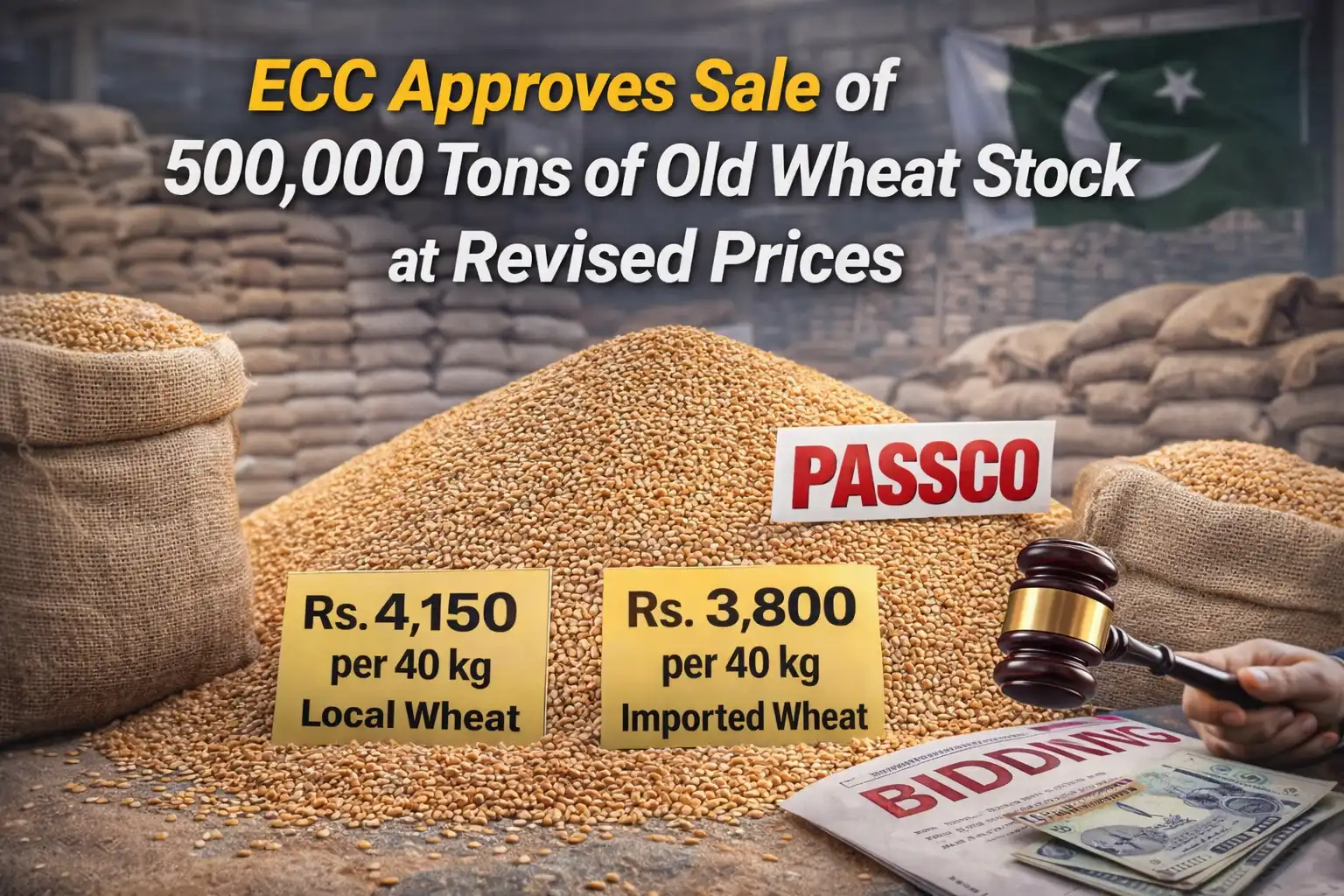
The Economic Coordination Committee (ECC) of the Cabinet has approved the sale of 500,000 metric tons of old wheat stock held by Pakistan Agricultural Storage and Services Corporation (PASSCO).
The wheat will be offloaded through competitive bidding under a First-In-First-Out (FIFO) policy. The decision comes after an earlier attempt to sell wheat at previously approved reserve prices failed due to low bids.
In this detailed article, we explain the revised wheat prices, reasons behind the decision, impact on flour prices, food security concerns, PASSCO’s role, and related ECC approvals in easy English.

Popular Google searches:
- ECC wheat decision 2026
- PASSCO wheat stock sale
- Wheat price per 40 kg Pakistan
- Imported wheat rate 2026
- FIFO wheat policy Pakistan
Why ECC Approved the Sale of Wheat Stock
The government is currently holding a large quantity of old wheat stock. Keeping wheat in storage for long periods increases:
- Storage costs
- Handling charges
- Risk of spoilage
- Financial burden on government
The ECC was informed that earlier efforts to sell wheat at higher reserve prices did not succeed because bidders offered lower rates.
Considering the stock position and carrying costs, the ECC approved the sale at revised prices.
Revised Reserve Prices for Wheat 2026
The ECC approved new reserve prices as follows:
Local Wheat
Rs. 4,150 per 40 kg
Imported Wheat
Search keywords:
- Wheat rate per 40 kg 2026
- Local wheat price Pakistan today
- Imported wheat price Pakistan
These revised prices are expected to attract more bidders and ensure successful disposal of stock.
What Is the FIFO Policy?
The wheat will be sold on a First-In-First-Out (FIFO) basis.
This means:
- Oldest stock will be sold first
- Fresh stock remains in storage
- Quality deterioration is minimized
Search queries:
- What is FIFO in wheat stock?
- PASSCO FIFO policy explained
Role of PASSCO in Wheat Storage
Pakistan Agricultural Storage and Services Corporation (PASSCO) is responsible for:
- Procuring wheat
- Maintaining strategic reserves
- Stabilizing market prices
- Ensuring food security
PASSCO buys wheat during harvest season and stores it for supply during shortages.
Impact on Flour Prices in Pakistan
The release of 500,000 metric tons could:
- Increase wheat supply in the market
- Stabilize flour prices
- Reduce pressure on inflation
- Support flour mills
Search trends:
- Atta price Pakistan today
- Wheat impact on flour price
- Food inflation Pakistan 2026
If supply increases significantly, retail prices of flour may stabilize.
Why Earlier Sale Attempt Failed
The ECC was informed that previous reserve prices were not attractive enough for buyers.
Low bids meant:
- No finalization of sale
- Continued storage costs
- Delayed market supply
Lowering reserve prices was considered necessary to complete the sale.
Financial Implications for Government
Storing large wheat stocks involves:
- Warehouse rent
- Security costs
- Transportation expenses
- Loss due to deterioration
By offloading stock, the government aims to:
- Reduce financial burden
- Improve cash flow
- Manage public sector inventories efficiently
ECC Also Approves Technical Supplementary Grant
In addition to the wheat decision, the ECC approved:
Rs. 536 million Technical Supplementary Grant
This grant is for PSDP projects of the defunct Pakistan Public Works Department (Pak-PWD).
The funds will be transferred to:
- Government of Punjab
- Government of Khyber Pakhtunkhwa
Search keywords:
- ECC supplementary grant 2026
- PSDP projects Punjab KP
Petroleum Division Summary on Cnergyico
The Petroleum Division presented a report regarding a Deed of Settlement with Cnergyico PK Limited.
The report concerned delayed Petroleum Levy payments.
However, the ECC returned the summary with observations, asking for a more comprehensive presentation in a future meeting.
Search queries:
- Cnergyico settlement Pakistan
- Petroleum Levy issue 2026
Ministers Attending the ECC Meeting
The meeting was attended by:
- Ali Pervaiz Malik – Federal Minister for Petroleum
- Rana Tanveer Hussain – Federal Minister for National Food Security & Research
- Qaiser Ahmed Sheikh – Federal Minister for Investment
- Haroon Akhtar Khan – Special Assistant to PM
Their presence highlights the importance of wheat and food security decisions.
Broader Impact on Pakistan’s Economy
Wheat is a staple food in Pakistan. Decisions regarding wheat stocks directly impact:
- Food security
- Inflation rates
- Rural economy
- Government subsidies
Search trends:
- Pakistan wheat production 2026
- Food security policy Pakistan
The ECC decision aims to balance supply and reduce economic pressure.
Final Thoughts
The ECC’s decision to approve the sale of 500,000 metric tons of wheat stock at revised prices is a significant move for managing Pakistan’s food reserves.
By lowering reserve prices and adopting a FIFO policy, the government aims to reduce storage costs, stabilize markets, and support food security.
The decision reflects the importance of efficient stock management in controlling inflation and ensuring steady wheat supply.
As wheat remains a critical commodity in Pakistan, such policy moves directly affect millions of consumers.