NADRA Introduces QR Code & New Features to CNICs Under SRO 330(I)/2026
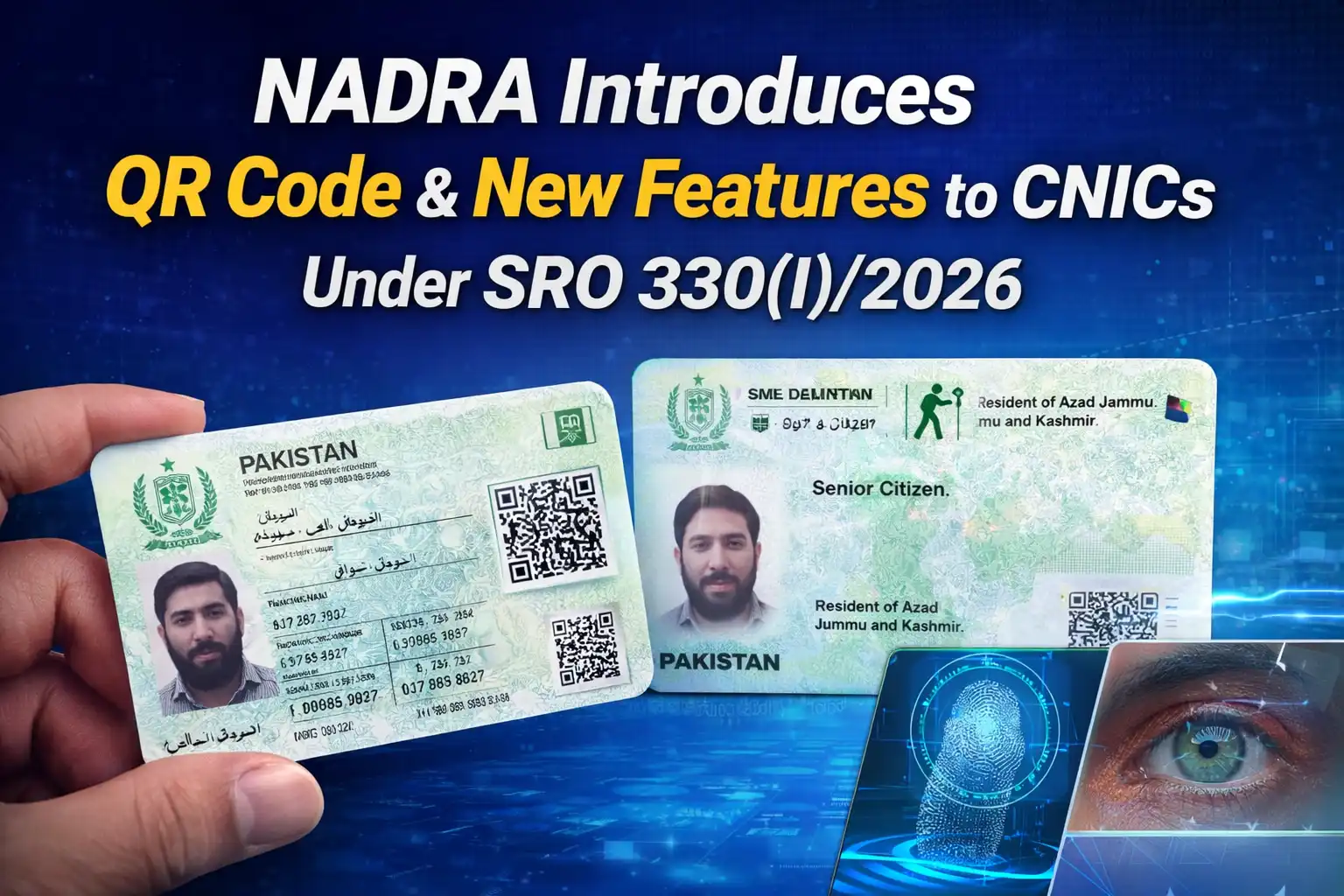
The Government of Pakistan has officially notified major amendments to the National Identity Card Rules, 2002 and Pakistan Origin Card Rules, 2002 through S.R.O. 330(I)/2026 and S.R.O. 331(I)/2026.
These amendments were issued under Section 44 of the National Database and Registration Authority (NADRA) Ordinance, 2000 and were published in the Gazette of Pakistan on 24 February 2026.
The new reforms modernize Pakistan’s CNIC system by introducing QR-based verification, expanding biometric recognition, updating card formats, and improving services for senior citizens.

In this detailed article, we explain everything in easy English, including new CNIC features, QR verification system, biometric updates, digital ID ecosystem improvements, and what this means for citizens.
Popular Google searches:
- NADRA new CNIC features 2026
- QR code CNIC Pakistan
- NADRA SRO 330(I)/2026 details
- Senior citizen CNIC lifetime validity
- New NADRA card design 2026
What Are the New NADRA Amendments 2026?
The amendments aim to modernize Pakistan’s identity document framework by:
- Legally introducing QR-based verification
- Strengthening authentication controls
- Expanding biometric recognition
- Updating card formats
- Improving digital service interoperability
These reforms are part of Pakistan’s growing Digital ID ecosystem.
QR Code Introduced in CNIC – What It Means
One of the most important changes is the statutory introduction of the Quick Response (QR) code.
The QR code is now legally defined as:
- A secure
- Machine-readable
- Two-dimensional barcode
- Capable of storing encoded identity data
When scanned, the QR code converts stored data into usable identity verification information.
Search keywords:
- QR code CNIC verification Pakistan
- How to scan NADRA QR code
- CNIC QR security feature
Why QR-Based Verification Is Important
Previously, two types of CNICs existed:
- Smart card with microchip
- Card without microchip
Now, NADRA can use QR code or any other technological feature instead of relying only on microchips.
This allows:
- Faster verification
- Offline and online authentication
- Reduced fraud risk
- Improved digital governance
This reform also enables all citizens to carry a similar card format.
Strengthening Pakistan’s Digital ID Ecosystem
The QR-enabled CNIC supports interoperability through the National Data Exchange Layer (NDX Layer).
This system allows:
- Government departments to verify identity instantly
- Secure backend authentication
- Reduced manual paperwork
- Improved transparency
Search trends:
- National Data Exchange Layer Pakistan
- Digital ID system Pakistan
- NADRA online verification system
Enhanced Security Through Card Suspension Controls
The amendments strengthen the effect of card suspension.
If a CNIC is suspended:
- All verification services linked to that card are immediately suspended
- Digital authentication stops instantly
- Institutional verification channels are blocked
This closes a major security gap and prevents misuse of suspended identity cards.
Search keywords:
- NADRA card suspension rules 2026
- Suspended CNIC verification
Expanded Biometric Recognition
The Rules now explicitly recognize:
- Fingerprints
- Iris scans
This strengthens Pakistan’s multi-modal biometric foundation.
Biometric updates improve:
- Identity assurance
- Fraud prevention
- Secure authentication
Search queries:
- NADRA biometric verification 2026
- Iris scan CNIC Pakistan
Lifetime Validity for Senior Citizens
A major citizen-friendly reform is introduced for senior citizens.
If a resident or non-resident citizen reaches 60 years of age:
- They will receive a CNIC with a distinct senior citizen logo
- The card will have lifetime validity
This eliminates the need for repeated renewals and reduces burden for elderly citizens.
Search keywords:
- Senior citizen CNIC lifetime validity
- NADRA new rule for 60 years age
Special Identification for AJK Residents
The amendments introduce standardized identification for residents of Azad Jammu and Kashmir (AJK).
CNICs will now carry an inscription:
“Resident of Azad Jammu and Kashmir”
This ensures uniform geographic identification.
Updated Card Formats for Multiple Categories
NADRA has updated specimen formats for:
- Resident citizens
- Overseas Pakistanis (NICOP)
- Pakistan Origin Card (POC) holders
- Child Registration Certificates
- Persons with disabilities
- Organ donors
- Combined category holders
- AJK residents
These formats now visibly incorporate:
- QR codes
- Enhanced security layouts
- Bilingual data fields
- Family number display
Search keywords:
- New CNIC design Pakistan 2026
- NADRA NICOP QR code
- POC new format
Impact on Overseas Pakistanis (NICOP & POC)
The reforms also affect:
- National Identity Card for Overseas Pakistanis (NICOP)
- Pakistan Origin Card (POC)
Additional information fields and bilingual data enhance global usability.
This makes Pakistani identity documents more internationally compatible.
Fraud Prevention & Transparency Improvements
QR verification and biometric expansion will:
- Reduce impersonation
- Lower identity fraud
- Improve service delivery speed
- Strengthen digital compliance
This is especially important in:
- Banking
- SIM registration
- Passport processing
- Tax verification
How These Changes Support Digital Governance
The reforms support integrated digital governance by:
- Enabling structured interoperability
- Strengthening digital authentication
- Improving public service efficiency
Pakistan is moving toward a more unified digital identity system aligned with global best practices.
Final Thoughts
The NADRA amendments under S.R.O. 330(I)/2026 and S.R.O. 331(I)/2026 represent one of the most significant upgrades to Pakistan’s identity system in recent years.
Key highlights include:
- QR-based CNIC verification
- Expanded biometric authentication
- Immediate suspension enforcement
- Lifetime CNIC for senior citizens
- Updated formats for multiple categories
These changes strengthen security, improve digital governance, and enhance citizen convenience.
Pakistan’s identity framework is now more modern, secure, and aligned with digital transformation goals.